 SubDyL Watch press · prices · collectors
The Founder's Loupe
Why the Gerald Charles Maestro GC Sport Tennis Turquoise deserves a closer look
A 100-piece turquoise edition of Gérald Genta's last case design, in Darkblast titanium with a slim Vaucher-built movement. Our founder on what works, what to check in the metal, and whether $26,300 is a serious proposition.
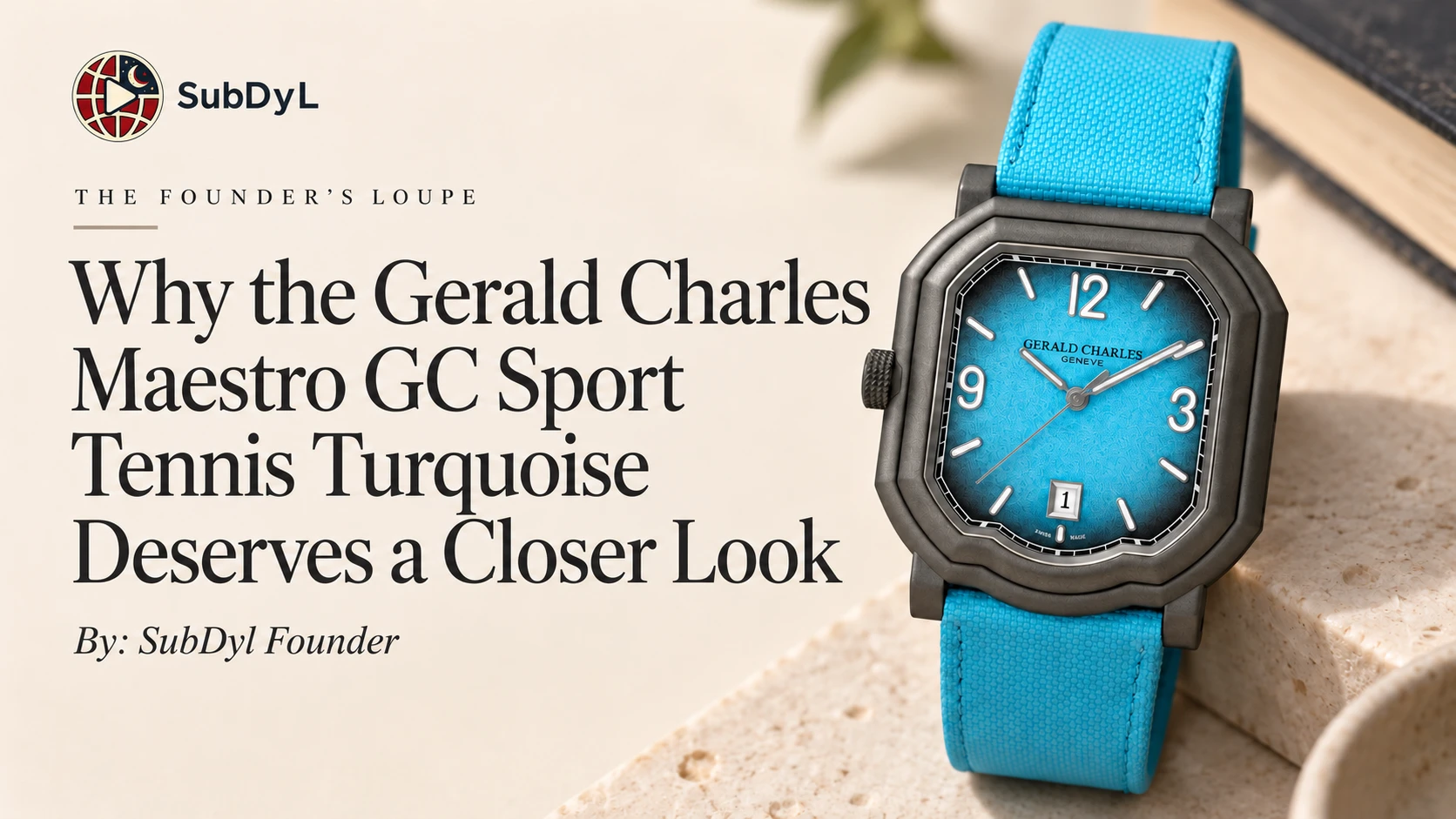
The first thing that draws me to the Gerald Charles Maestro GC Sport Tennis Turquoise is the way its colour changes the character of that unmistakable case. The bright centre, the dark perimeter and the matching strap make the watch feel playful, while the architecture keeps it serious. As the founder of SubDyL, I am interested in releases that give collectors something worth discussing beyond another familiar silhouette. This one certainly does.
Presented during Geneva Watch Days 2026, the Turquoise introduces a new light-turquoise shade to the Maestro GC Sport collection. Production is limited to 100 pieces worldwide. The launch reference is GC2.0-TX-TNDB-33GR-RSVC_DLE, and the verified U.S. asking price is $26,300 before sales tax. Those details immediately establish the audience: collectors considering a distinctive luxury sports watch, with a willingness to pay for design individuality as well as mechanical substance. 1, 2
The name on the dial
Understanding the name on the dial makes this release considerably more interesting. Gérald Charles Genta founded Gerald Charles in 2000, using his first and middle names. This was the designer responsible for the Royal Oak and the Nautilus, pursuing another chapter of his own creative work. In 2003 he entrusted the business to the Ziviani family and remained its chief designer until 2011. The contemporary company continues to draw on his original designs. 4
That history matters to me because it changes how I read the Maestro. I see a late expression of Genta's imagination, carried forward through a living company. The temptation is always to judge anything associated with him against his most famous designs. Here, I would encourage collectors to set that comparison aside for a moment and enjoy the unusual freedom of the shape itself. Its appeal becomes clearer when it receives that space.
The case
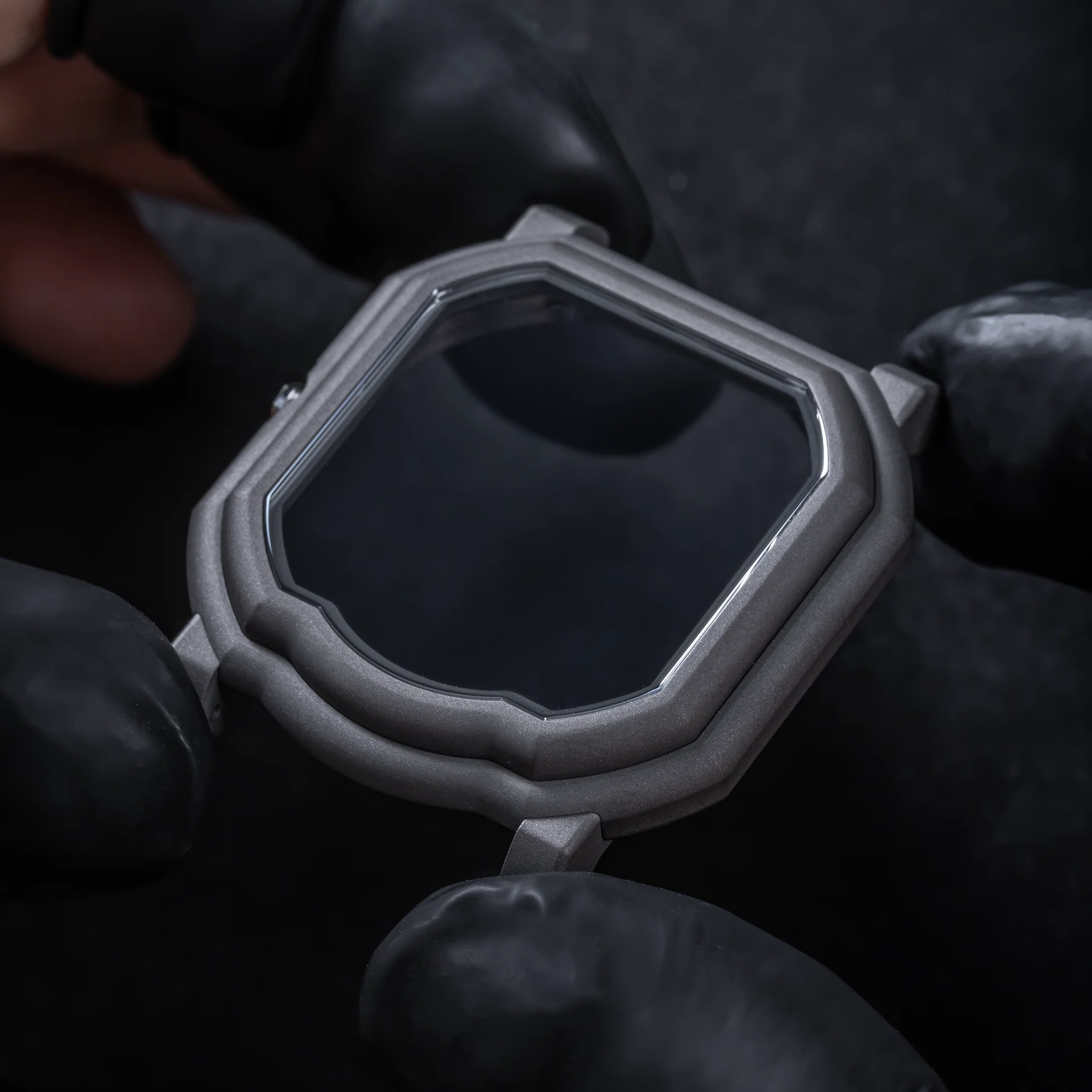
The Maestro case dates to 2005. Its architectural inspiration comes from Francesco Borromini's seventeenth-century Baroque work, translated into a form somewhere between a square and an octagon. The curved indentation at six o'clock, often called the Maestro's smile, gives the lower edge its unmistakable identity. Look at the stepped outline and that inward curve together: the design has a rhythm that a conventional round case simply cannot reproduce. 4
I suspect this will be the decisive feature for many buyers. If the case speaks to you, the turquoise treatment gives it an especially expressive personality. If you prefer strict symmetry, the Maestro may remain a difficult proposition. That is a perfectly reasonable response. A watch this individual does not need universal approval. In a collection, I would want it to earn its place through the pleasure of looking at it repeatedly.
The case uses Grade 5 titanium with Gerald Charles's Darkblast finish, which the brand describes as a proprietary sandblasting technique developed in-house to improve the metal's resistance to corrosion and scratches. That distinction is worth preserving, because dark watches are casually grouped together as DLC, and this is a surface treatment of the titanium itself rather than a coating laid on top of it. Here, the subdued surface gives the turquoise room to stand out without a reflective metal frame competing for attention. 3
There is a small specification discrepancy buyers should know about. Launch coverage lists 39 by 41 millimetres and 9 millimetres thick, with a total weight of 64 grams; the brand's own GC Sport Tennis product page gives 39 by 41.7 millimetres and 8.7 millimetres thick. Both describe a compact, slim watch, but the figures are not identical, and I would ask the retailer to confirm the delivered reference's dimensions. 1, 3
Those proportions are promising, although comfort remains something to judge on your own wrist. A shaped case can distribute its presence very differently from a circular watch with the same stated width. My fitting priorities would be straightforward: whether the lugs settle naturally, whether the strap holds the head securely, and whether the lower curve sits comfortably when the wrist moves. A few quiet minutes at a counter would tell me more than another promotional wrist photograph.
The construction deserves closer inspection as well. The brand lists 35 case components and a 22-millimetre distance between the lugs. For a collector examining it in person, I would pay particular attention to how the layered bezel follows the lower curve, and how cleanly the strap meets the case. Those junctions are where an ambitious silhouette has to become a convincing object from every angle. 3
The dial
The dial is the emotional centre of this release. Its grained texture and graduated turquoise finish create a lighter central area surrounded by a darker edge. That arrangement gives the colour somewhere to travel. In the published imagery, the result feels more dimensional than a flat pastel surface. My favourite aspect is the connection between the dark outer dial and the case: the transition helps the entire face read as one composition. 2, 6
Applied Arabic numerals at twelve, three and nine share space with baton markers. A white minute track frames the display, while the baton hands and the hour markers carry Super-LumiNova. A date window sits at six o'clock, white disc, black numeral. I appreciate that practical interruption. It establishes a useful visual anchor above the case's smile and keeps the display focused on everyday reading. 3, 9
Protecting the dial is a sapphire crystal, and a flat sapphire crystal also opens the caseback to the movement. Water resistance is rated at 100 metres, or 10 ATM. These details make the watch more convincing as something intended for regular wear, although the actual experience of glare, night visibility and sustained comfort still deserves an independent test. 2, 5
The tennis connection
The tennis connection has a practical history. The GC Sport line was developed with input from a trio of ATP Tour players, and the most visible result is the screw-down crown on the left side of the case, which reduces the rubbing a conventional crown position causes against the back of the hand during play. 5, 1
For someone wearing the watch on the left wrist, that crown placement is an appealing piece of reasoning. The crown carries a Clous de Paris grip pattern, and the brand's broader ergonomic approach coordinates case curvature, lugs and strap architecture to improve contact and stability. I like seeing attention given to those relationships. A sports watch's usefulness depends on how the complete object behaves while you move.
The brand states 5G shock resistance and says the testing uses a five-axis robotic arm. That is a manufacturer claim, rather than an independent result from SubDyL. I would treat it as evidence of the design brief and ask about recommended use before taking a watch at this price onto a court. The attractive part is the ambition to make a thin mechanical watch accommodate activity while retaining the finishing and visual interest collectors expect. 3
The movement
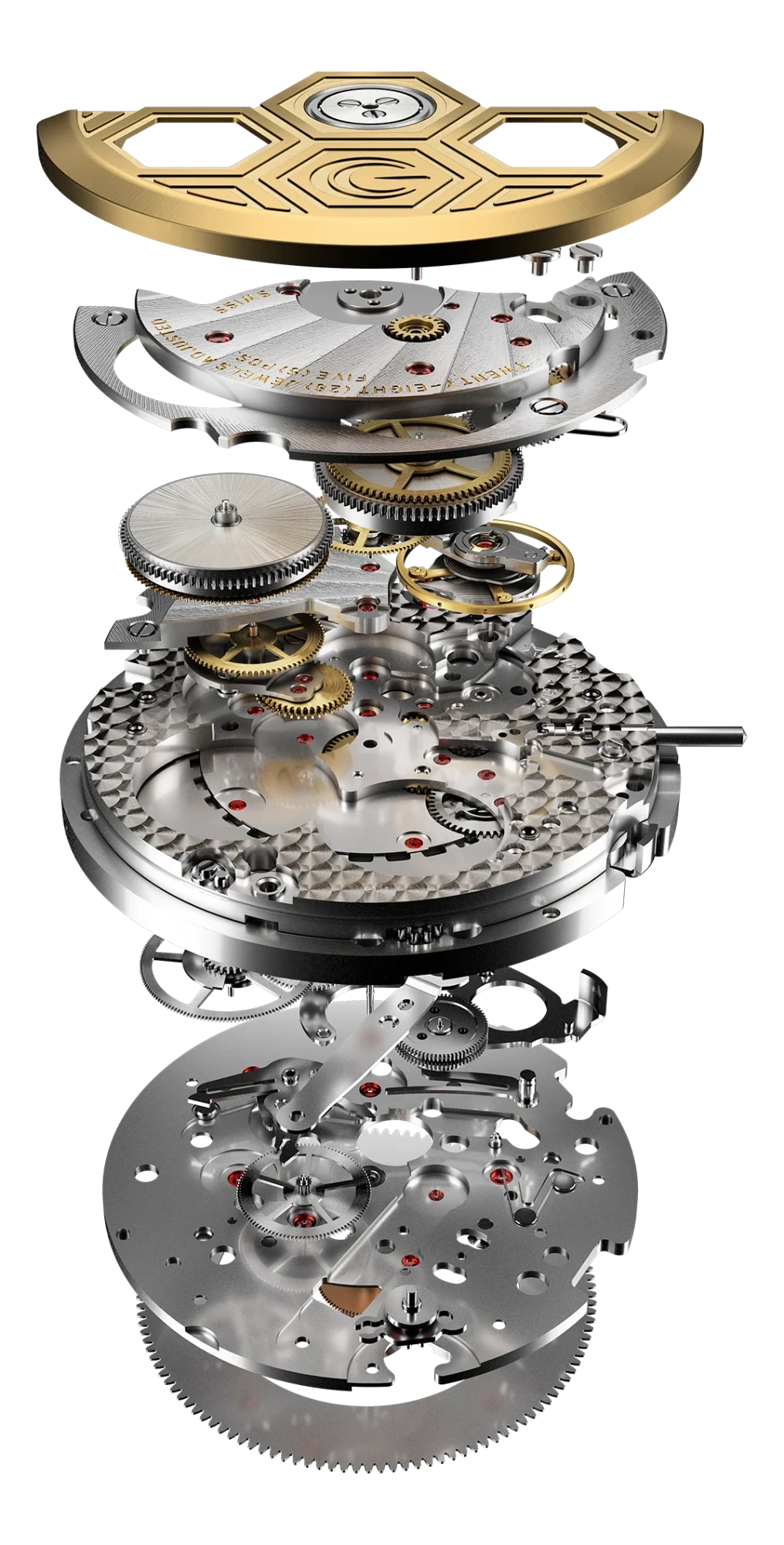
Inside is the automatic calibre GCA2001. It measures 3.7 millimetres thick, contains 189 components, and runs at 4 Hz, or 28,800 vibrations per hour. The rotor-side bridge is engraved with its 28 jewels. Functions are central hours, minutes and seconds, plus the date, with an Incabloc system for shock protection. 3
The stated power reserve is 50 hours, from a twin-barrel arrangement. For my collecting habits, the important trade-off is thinness against autonomy. Fifty hours is useful, but anyone wanting to leave a watch untouched through an extended weekend should account for that limit. Here, I find the slender mechanical package more compelling than chasing the longest possible reserve. It supports the proportions that make the entire design attractive. 3
Movement provenance also deserves clear language. Monochrome's launch report identifies Vaucher Manufacture Fleurier as the maker of this calibre, and I would describe that relationship openly when discussing the watch. Specialist collaboration can be part of the appeal, particularly for collectors who care about the people and workshops behind a calibre. The thin architecture, the decorative finish and the suitability for this particular watch are what deserve the attention. 1
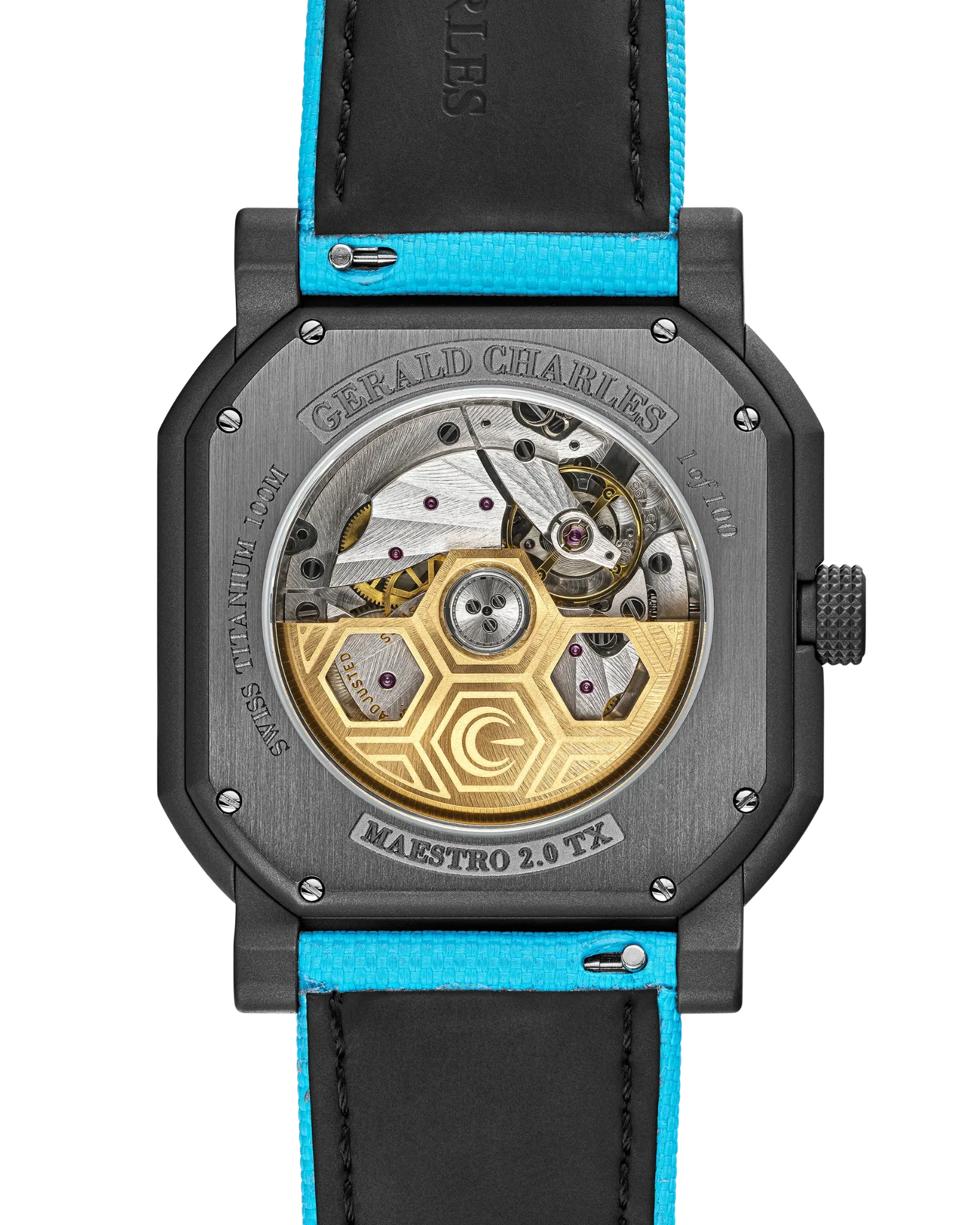
Through the display back, the decorative vocabulary includes Côtes de Genève and perlage. The central winding rotor carries Gerald Charles's honeycomb motif in a gold tone. These are details I would spend time examining with a loupe. The front already supplies plenty of personality, and a thoughtfully presented movement gives the owner another reason to enjoy the watch away from the wrist.
The strap
The matching turquoise Velcro strap completes the design. Gerald Charles describes its GC Sport Tennis straps as hand-stitched with an internal iron core, closed by an integrated Darkblast buckle, and offered in S, M, L and XL. I would make sizing part of the purchase conversation immediately. The strap is visually central to this edition, so its fit and the availability of future replacements matter more than they might on a generic strap-equipped watch. 3
One hundred pieces
The edition size adds another reason for collectors to pay attention. One hundred examples is a clearly defined production run. For context, the earlier Optic Yellow Tennis edition was announced at 200 pieces, so the turquoise has the smaller declared run. That comparison tells us something concrete about supply; it does not tell us how many watches remain available today. 2, 7
My interest would still begin with the watch itself. I would want the shape and colour to hold their appeal after the excitement of a new release fades. Would I reach for it on an ordinary Saturday? Would it bring something different to the watches I already enjoy? Those questions feel more useful than treating the production number as the main attraction. Rarity strengthens a purchase I already want to make; it should not have to manufacture the desire.
Price and where to buy
For U.S. buyers, the clearest verified price is $26,300 before sales tax, on Watches of Switzerland's U.S. listing. Monochrome's launch coverage reports CHF 20,000 or EUR 20,000 excluding VAT, and T3 quotes £22,800 in the U.K. These are regional published prices with different tax treatment, so request a current local quotation rather than assuming that a currency conversion produces the final bill. Pricing was checked on October 17, 2026. 1, 2, 8
Start with the official Gerald Charles website, which has an information request and an authorized retailer search. Watches of Switzerland has a dedicated U.S. product listing for the turquoise model, showing in-store pickup and short delivery estimates at the time of writing. Oster Jewelers in Denver also carries the brand. A retailer carrying Gerald Charles does not by itself establish stock of this particular edition, so ask specifically for the turquoise reference. 2, 3, 10
I cannot confirm how many of the 100 pieces remain unsold. Before paying, I would obtain written confirmation of allocation, delivery timing, strap size and the complete price, and I would ask the retailer to explain warranty registration and service arrangements. Replacement straps and service logistics deserve a conversation at this level of ownership.
Verdict
The Maestro GC Sport Tennis Turquoise succeeds most convincingly as a collector's watch with an unusually cheerful disposition. The case supplies the identity; the colour makes me want to keep looking. Its specifications give that first impression something substantial to rest on, while the price demands a personal connection stronger than casual admiration. For the collector who loves this particular shape and wants a bright, distinctive expression of it, this is a release worth seeking out and trying on. I would give it serious wrist time before deciding, then buy only if that initial delight survives the quieter moments too, with the colour still inviting another glance.
Sources and buying links
Checked October 17, 2026. Product images courtesy of Gerald Charles.
- Monochrome Watches, launch report (2 October 2026): reference, 100 pieces, dimensions and weight, Vaucher-made GCA2001, CHF/EUR price.
- Watches of Switzerland U.S. product listing: $26,300, limited edition of 100, 100 m, 50-hour reserve, purchase option.
- Gerald Charles, Maestro GC Sport Tennis product page: case and movement specifications, Darkblast, 5G testing, strap construction and sizes.
- Gerald Charles, La Maison: the brand's history, the Ziviani family, the 2005 Maestro case and Borromini.
- Watchonista, Maestro GC Sport Tennis Turquoise: Geneva Watch Days 2026 launch, ATP player input, 10 ATM.
- aBlogtoWatch, new release coverage: dial colour and case finish.
- Monochrome Watches, Optic Yellow edition (2025): the 200-piece yellow run.
- T3, launch coverage: £22,800 U.K. price, 64 grams.
- Wikipedia, Gerald Charles: founding and ownership timeline.
- Oster Jewelers, Gerald Charles collection: authorized U.S. retailer.